
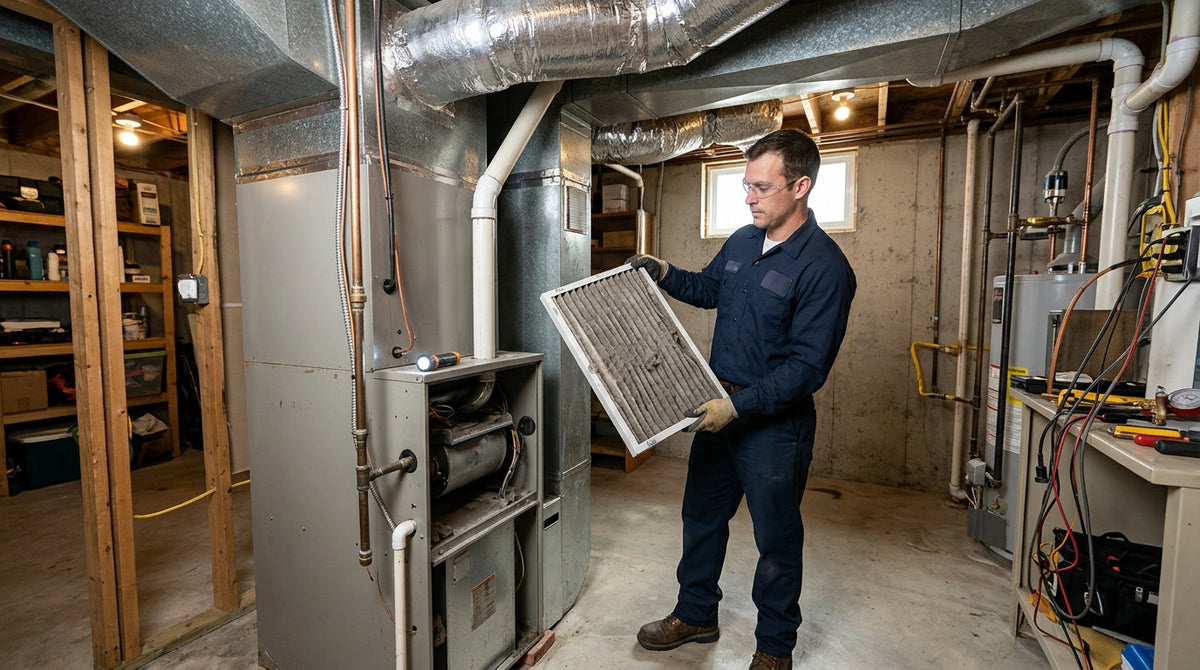
A frozen evaporator, low suction pressure and a warm house look like a low charge. Very often they are an airflow problem in disguise. Add refrigerant to a system with a choked filter and you have overcharged it, and the frozen coil comes back the moment someone changes the filter.
How airflow changes the readings
The evaporator can only absorb the heat that the air brings to it. Cut the airflow and the coil gets less heat to boil the refrigerant. Suction pressure and coil temperature drop, superheat on a fixed orifice system falls, and if the coil drops below freezing, moisture from the air turns to ice. The ice blocks even more airflow, and the problem feeds itself.
Most systems are designed around roughly 350 to 450 cubic feet per minute of air per ton of cooling, with 400 CFM per ton a common starting point. Humid climates often run lower to remove more moisture. The manufacturer's data sets the number for the equipment in front of you.
The usual suspects
- A dirty or overly restrictive filter
- A dirty evaporator coil, often from filters that were missing or did not fit
- Closed, blocked or missing registers and grilles
- Crushed, disconnected or undersized ductwork
- A blower set to the wrong speed, or a blower wheel caked with dust
- A failing blower motor or blower capacitor
Measure it, don't guess it
A manometer turns airflow from a hunch into a number. Total external static pressure, measured where air enters and leaves the air handler, shows how hard the blower is working against the duct system. Compare it with the equipment's rated external static pressure and the blower table. A high reading points to restrictions such as filters, coils or ducts. A normal reading with poor airflow points back to the blower.
Temperature split across the coil is a useful clue too, but it changes with humidity, so treat it as a hint rather than a verdict.
The cheapest fix in the trade
The Department of Energy estimates that replacing or cleaning a dirty air filter can lower an air conditioner's energy use by 5 to 15 percent. Start every cooling call by pulling the filter and looking at the coil. It takes two minutes and rules out the most common cause before you open a single valve.
Read more in The Code: airflow.