
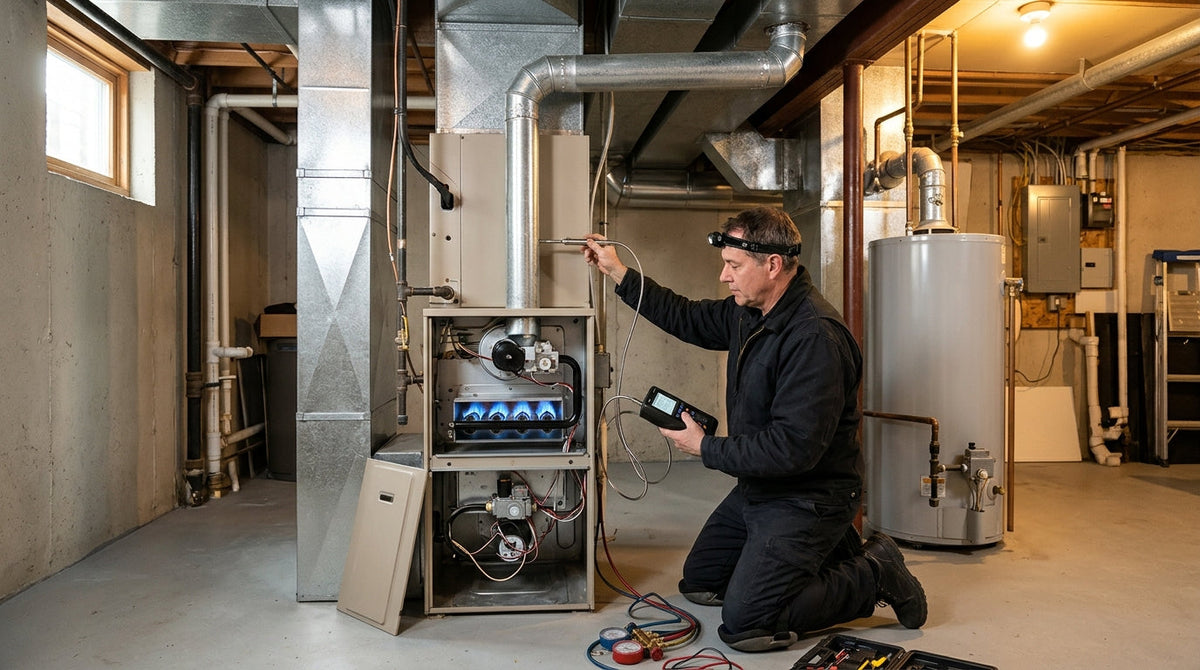
A modern induced-draft furnace does not just light. It runs a fixed sequence, and each step has to be proven before the next one starts. That is good news for troubleshooting: when a furnace fails, it fails at a specific step, and the step tells you what to test.
The sequence
- Call for heat. The thermostat connects R to W, sending 24 volts to the control board.
- Inducer starts. The inducer motor purges the heat exchanger and pulls combustion gases toward the vent.
- Pressure switch closes. The draft from the inducer closes the pressure switch, proving the vent path is open.
- Igniter heats. The hot surface igniter warms up until it glows.
- Gas valve opens. The board energizes the gas valve and the burners light.
- Flame is proven. Within a few seconds the flame sensor must detect the flame. If it does, the igniter shuts off and the furnace keeps firing.
- Blower starts. After a delay that lets the heat exchanger warm up, the blower carries heat into the house.
Where it stops tells you why
- Inducer never starts: no call reaching the board, a failed inducer or a board problem.
- Inducer runs, nothing else happens: the pressure switch is not closing. Look for a blocked vent or intake, a blocked condensate drain on a condensing furnace, a cracked hose or a failed switch.
- Igniter does not glow: a cracked igniter or no voltage reaching it.
- Igniter glows, no flame: no 24 volts to the gas valve, a failed valve or no gas supply.
- Lights, then shuts off after a few seconds: the flame is not being proven, most often because of a dirty or poorly grounded flame sensor.
Flame proving, briefly
The flame sensor relies on flame rectification. The board puts an AC voltage on the sensor rod, and the flame conducts a tiny DC current back to ground, measured in microamps. Oxidation on the rod or a poor ground lowers that signal. Clean the sensor gently, check the burner ground, then compare the reading with the manufacturer's minimum.
Respect the safeties
The high limit and flame rollout switches are there for a reason. A tripped limit usually points to low airflow. A tripped rollout switch points to flame where it should not be, for example from a blocked heat exchanger or vent. Find the cause, test combustion and make sure the home has working carbon monoxide alarms. Never jump a safety to get the heat back on.
Test yourself with the Gas Furnace Ignition Quiz.