
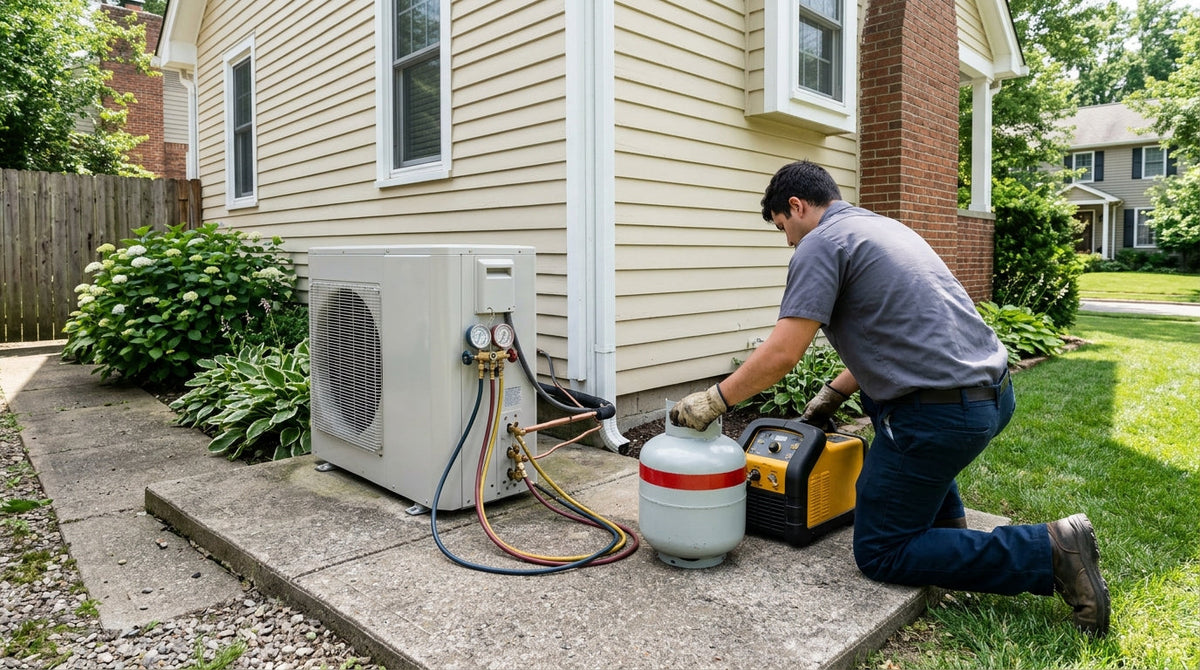
Since January 1, 2025, new residential and light commercial air conditioners and heat pumps for the US market have had to use a refrigerant with a global warming potential below 700, under EPA's Technology Transitions rule. Most manufacturers moved to R-32 or R-454B. In May 2026 EPA also removed the January 1, 2026 installation deadline for systems built or imported before 2025, so existing R-410A inventory can still be installed until it runs out, and existing R-410A systems can still be serviced.
So you will be working on both for years. Here is what changes with the new refrigerants.
What A2L means
A2L is a safety classification: A for lower toxicity, 2L for lower flammability. These refrigerants are hard to ignite and burn slowly, but they can burn, which R-410A cannot. Most of the changes on the job follow from that one fact.
Tools and equipment
- Recovery machines, vacuum pumps and leak detectors should be rated by their manufacturer for A2L refrigerants. Many recent tools are; older ones may not be.
- Cylinders for A2L refrigerants have left-hand threaded valves, so you need matching adapters and hoses.
- Manifolds and PT charts need the correct refrigerant setting. R-454B has a small temperature glide, so use dew point values for superheat and bubble point values for subcooling.
Habits on site
- Keep ignition sources away from an open refrigerant circuit, and ventilate the work area.
- Recover the refrigerant fully and purge before you open a circuit to braze.
- Follow the manufacturer's instructions for charge limits, line set lengths and room size requirements.
Refrigerant detection systems
Equipment designed for A2L refrigerants is listed to UL 60335-2-40, which can require a refrigerant detection system. The sensor watches for a leak and, if it finds one, the system responds, typically by running the indoor blower to dilute the refrigerant. Never bypass a detection system. Test it and replace sensors as the manufacturer directs, and explain to the homeowner why the blower may run on its own.
What stays the same
The refrigeration cycle, superheat and subcooling, deep vacuums, nitrogen pressure tests and weighing in the charge all work exactly as before. The fundamentals transfer. What changes is the care you take around ignition and the equipment you carry.
Read more in The Code: A2L refrigerants.