
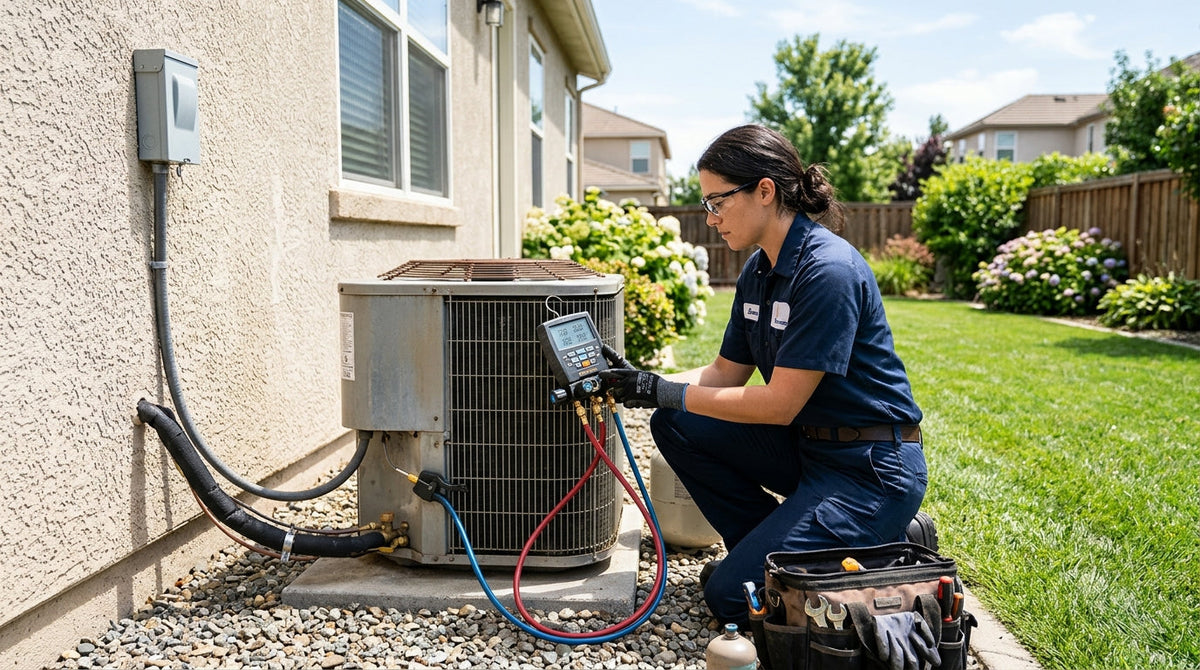
Ask ten techs how they check a charge and you will hear superheat from some and subcooling from others. Both camps are right, on different systems. The reading that tells you about the charge depends on one part: the metering device.
What each reading measures
Superheat is the temperature of the suction line minus the evaporator's saturation temperature, which you read from suction pressure on a PT chart. It tells you how far past boiling the vapor has warmed by the time it leaves the coil. Subcooling is the condenser's saturation temperature, read from liquid pressure, minus the actual liquid line temperature. It tells you how far below condensing the liquid has cooled before it heads to the metering device.
Put simply, superheat describes the low side and how fully the evaporator is fed. Subcooling describes the high side and how much liquid is stacked in the condenser.
Fixed orifice: superheat moves with the charge
A piston or capillary tube has a fixed opening. It cannot open wider when the evaporator is starving or close down when it is flooding, so the amount of refrigerant in the system directly changes how much reaches the coil. Add refrigerant and superheat falls; remove some and superheat rises. That makes superheat the reading to charge by on these systems.
The right superheat changes with conditions. A system running on a hot, humid afternoon needs a different superheat from the same system on a mild, dry morning, so you work out a target from indoor wet bulb and outdoor dry bulb with the manufacturer's chart or a target superheat calculator. Then you adjust the charge until the measured superheat matches the target.
TXV and EEV: subcooling moves with the charge
A thermostatic or electronic expansion valve exists to hold superheat steady. Starve it and it opens; flood it and it closes. Within its range it keeps superheat close to its setting however much refrigerant you add or remove, which is exactly why superheat stops telling you anything useful about the charge on these systems.
What does change is subcooling. Extra refrigerant has to go somewhere, and it backs up as liquid in the condenser, raising subcooling. So on TXV and EEV systems you charge to the subcooling listed on the unit's data plate or in its installation instructions.
Before either reading means anything
- Airflow first. A dirty filter or a slow blower lowers suction pressure and makes a correctly charged system look undercharged. Fix airflow before you touch the charge.
- Let it settle. Run the system ten to fifteen minutes under a steady load before trusting the numbers.
- Measure in the right place. Take line temperatures close to where the pressures are read, with probes insulated from the outdoor air.
- Use the right refrigerant. A PT chart for the wrong refrigerant makes every calculation wrong. With a blend such as R-454B, use dew point values for superheat and bubble point values for subcooling.
When the system is empty, weigh it
If the system has been opened, evacuated and is being charged from empty, neither reading should be your main tool. Weigh in the factory charge plus any line-set adjustment from the installation instructions, then use superheat or subcooling to confirm the result once the system has settled. The scale tells you how much went in. The readings tell you whether the system agrees.
Test yourself with the Checking the Charge Quiz.