
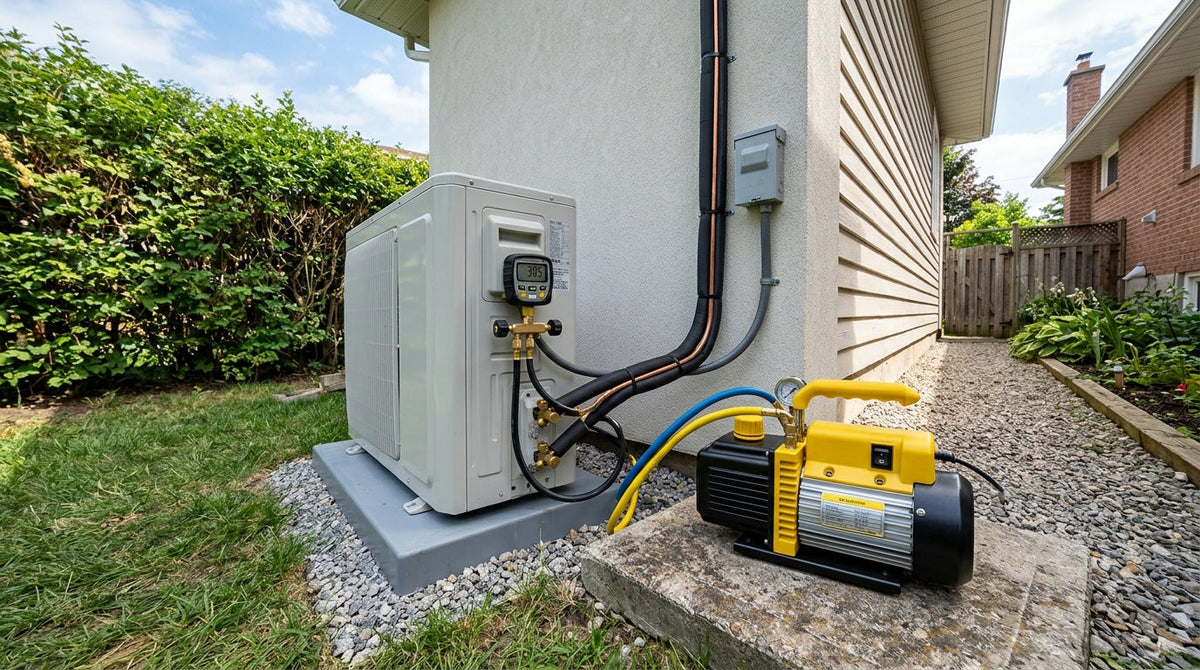
Most installation instructions call for a vacuum of 500 microns or lower before the refrigerant goes in, and plenty of techs treat that number as the finish line. It isn't. Reaching 500 microns tells you the pump got there. What happens after you close it off tells you whether the system is actually dry and tight.
Why we pull a vacuum at all
A new or opened system is full of air and some moisture. Air does not condense in the condenser, so it takes up room and raises head pressure. Moisture is worse: with refrigerant and oil it forms acids and sludge, and in the low side it can freeze at the metering device. Evacuation lowers the pressure so far that water boils at room temperature and leaves as vapor, along with the air.
Measure where it counts
A compound gauge cannot read this range at all. You need a micron gauge, and where you put it matters. Mounted at the pump, it reads the pump. Mounted at the system, as far from the pump as practical, it reads what the system has actually reached. The hoses and Schrader cores between the two are a big restriction, so pull the cores with a core removal tool and use short, large-diameter hoses. The job gets several times faster.
The decay test is the real result
Once you reach your target, isolate the pump from the system and watch the micron gauge. It will tell you one of three things:
- It holds, or rises a little and stops. The system is dry and tight. Check the result against the manufacturer's acceptance value and move on.
- It rises, then levels off. Moisture is still boiling off, and the rise stops when the pressure reaches the vapor pressure of the remaining water. Keep evacuating.
- It climbs steadily and keeps going. Air is getting in. That is a leak, and no amount of pumping will fix it. Stop, pressure test with dry nitrogen, find it and repair it.
Small habits that save an hour
- Pressure test with nitrogen before you evacuate. Finding a leak under pressure with bubble solution is far easier than chasing one at 2,000 microns.
- Change the vacuum pump oil often. Oil that has absorbed moisture limits how deep the pump can pull.
- Check your hoses and gauge on their own first. A leaking hose looks exactly like a leaking system.
- Break the vacuum with the system's refrigerant or dry nitrogen, never with air.
A vacuum is a measurement, not a timer. Thirty minutes on the clock tells you nothing; a decay test tells you what you need to know.
Test yourself with the Vacuum Pump Procedure Quiz.