
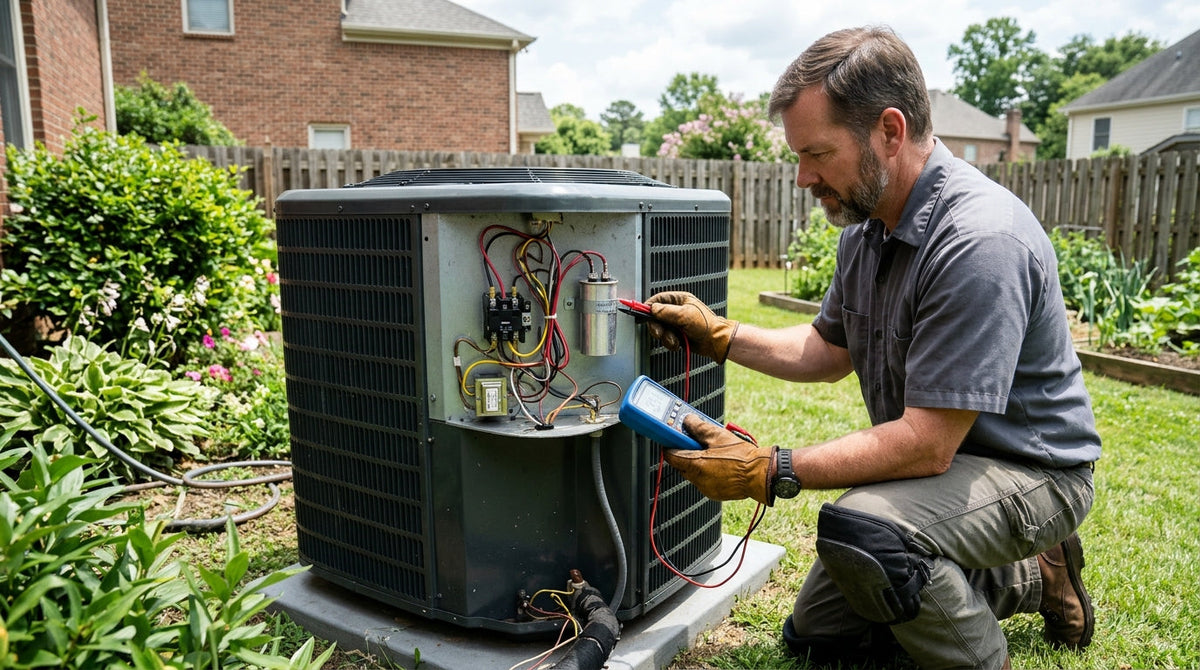
Run capacitors are among the most replaced parts in residential HVAC, and for good reason: they fail often, and a weak one causes symptoms that look like bigger problems. A compressor that hums and trips, a condenser fan that only starts with a push, a motor running hot. A proper capacitor test takes a few minutes and settles the question.
Safety first: discharge it
A capacitor can hold a dangerous charge after the power is off. Turn the power off at the disconnect, confirm it is off with your meter, then discharge the capacitor safely, for example with an insulated tool and a suitable resistor across the terminals. Disconnect at least one lead from each section you test, so the rest of the circuit does not affect the reading.
Read the label
Every run capacitor lists its capacitance in microfarads (µF), its voltage rating and its tolerance, such as 45 µF ±6%. A dual capacitor has two ratings, such as 45+5 µF. The larger section is for the compressor (HERM), the smaller for the condenser fan (FAN), and C is common to both.
Measure the capacitance
Set your meter to capacitance and measure each section: C to HERM, then C to FAN. Compare each reading with the rated value and its tolerance. For a 45 µF ±6% section, six percent of 45 is 2.7, so anything from about 42.3 to 47.7 µF is in range. A reading of 40 µF is below tolerance, and the capacitor should be replaced.
Check it under load if needed
A capacitor can measure fine on the bench and still struggle in the circuit. With the system running, you can measure the current through the capacitor's circuit with a clamp meter and the voltage across the capacitor, then estimate its value on 60 Hz power as µF = 2,652 × amps ÷ volts. Compare the result with the rating the same way.
Look for the obvious
- A swollen or domed top usually means the capacitor has failed internally.
- Leaking oil or burned terminals are reasons to replace it, whatever the reading.
- Replace like for like: the same capacitance, and a voltage rating equal to or higher than the original. Never go lower on voltage.
- Note the wiring before you remove the old one, and land each wire on the matching terminal of the new one.
A capacitor test is quick, cheap and conclusive. Replacing the capacitor is only a symptom fix if something else, such as a failing motor or high head pressure, is wearing capacitors out, so ask why it failed.
Test yourself with the Electrical Component Quiz.